
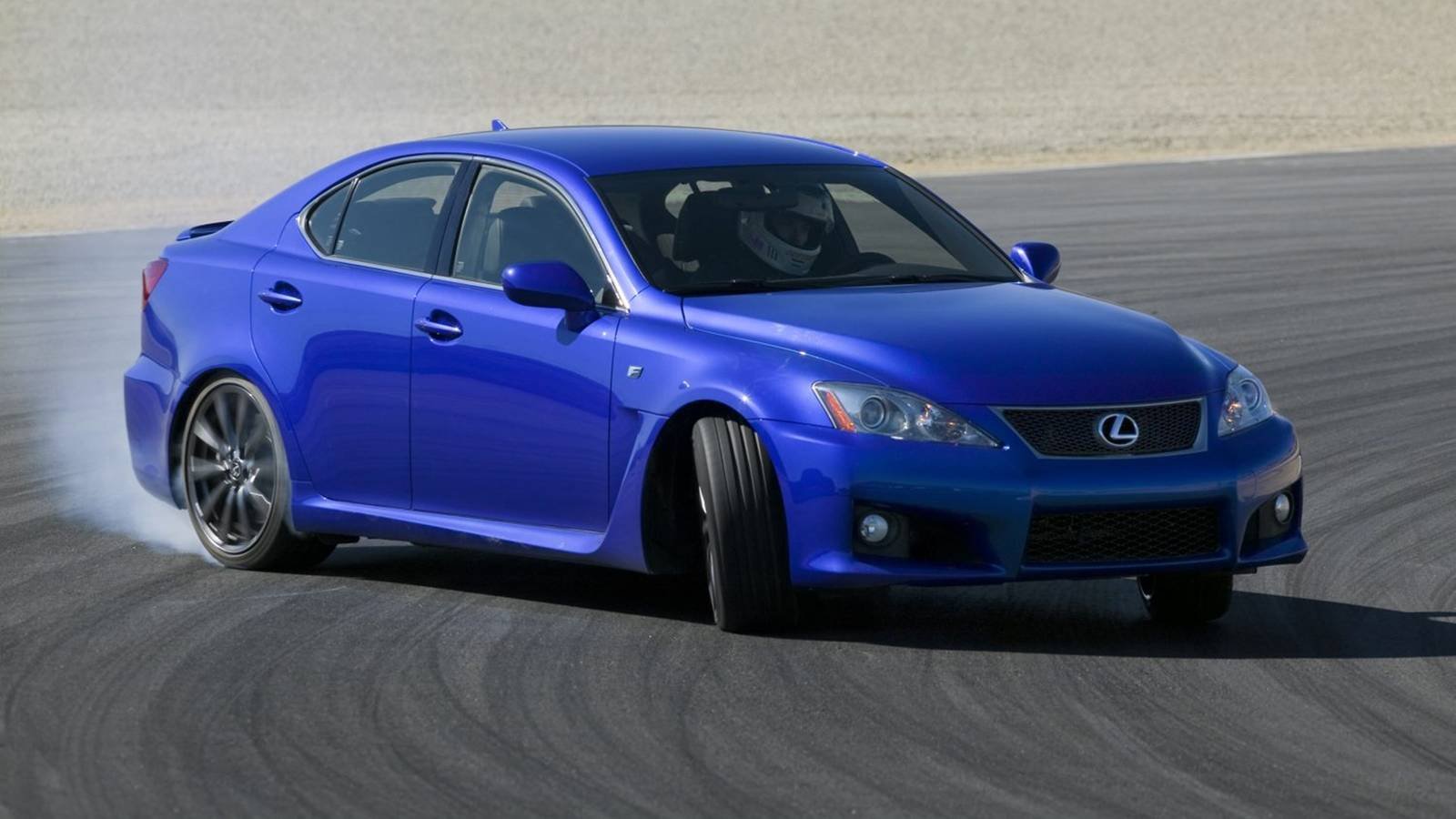
There was a time when the performance sedan hierarchy felt locked in place. BMW’s M division dominated the enthusiast conversation, Mercedes-AMG owned the drama and soundtrack, and Audi positioned itself as the all-weather performance alternative. Lexus, meanwhile, was known for refinement, reliability, and doing things properly — quietly. So, when the Lexus IS F arrived in 2008, it didn’t just surprise people. It confused them. This wasn’t how a performance sedan was supposed to show up. There was no motorsport pedigree being waved around, no wild body kit, no attempt to outshout the Germans.
The IS F didn’t beg for attention, and it certainly didn’t chase trends. Instead, Lexus delivered something far rarer than flash: a naturally aspirated V-8 sports sedan built with Japanese precision and, of course, luxury flair, with an obsessive focus on durability. While the rest of the industry argued about badges and headline horsepower, Lexus was playing a longer game — even if no one realized it at the time. Naturally, it sounded epic at the time, and perhaps a different take than the Germans’. Back then, the IS F felt slightly out of step with the market. Too subtle. Too expensive. Too restrained. And yet, more than a decade later, those same qualities have become the very reasons enthusiasts are finally giving it the recognition it deserves.
How Lexus Quietly Entered The Performance Sedan Wars

Before the IS F, Lexus wasn’t part of the performance sedan conversation. The brand’s reputation was built on comfort, quality, and reliability — not tire smoke or lap records. That began to change in the mid-2000s. Think of it like a revolution for the auto industry, when Lexus engineers started pushing the limits of the IS platform to see how far it could go without abandoning the brand’s core values.

The brief wasn’t to dethrone or outshine the BMW M, or out-muscle AMG, which these days seems to have lost the plot, as seen in the 2.0-liter four-cylinder turbocharged hybridized C63 SE Performance. Lexus aimed to create a performance sedan that could be driven hard every day, without the fragility or compromises often associated with high-strung performance cars. That philosophy shaped every aspect of the IS F, from its engine tuning to its chassis calibration.

Unlike its European rivals, Lexus didn’t have decades of racing heritage to lean on. The IS wasn’t a continuation of an established bloodline — it was a statement of intent. It also introduced the “F” performance badge, named after Fuji Speedway, signaling that Lexus was serious about entering enthusiast territory.

The problem was perception. Buyers weren’t sure whether Lexus truly belonged in the same conversation as the established heavyweights. That uncertainty followed the IS F throughout its early life. Critics acknowledged its capability, but struggled to reconcile the Lexus badge with a hard-edged performance mission. In hindsight, that hesitation explains much of why the IS F slipped under the radar when it mattered most. And it was, at the time, easy to forget due to the market being obsessed with either Bavaria’s finest fruits or AMG sweet treats.
The Naturally Aspirated V8 That Set The IS F Apart

At the heart of the IS F lies its defining feature: a 5.0-liter naturally aspirated V8. In today’s automotive landscape, that alone feels special. Producing just over 400 horsepower and revving eagerly toward its redline, the engine delivers a crisp, linear throttle response that turbocharged rivals can’t replicate. And that sounds delightful, really. What a time to be in, one can only imagine. This wasn’t a parts-bin motor assembled for effect. Lexus engineered it specifically for high-revving performance, with lightweight internals and a distinctive intake note that builds character the harder you push it.
2008 Lexus IS F Performance Specs
|
Engine |
5.0-liter NA V8 |
|
Horsepower |
416 |
|
Torque |
371 lb.-ft. |
|
Transmission |
8-speed auto |
|
Driveline |
RWD |
More importantly, it was designed to last. While some European performance sedans of the same era gained reputations for complexity and reliability concerns, IS F owners regularly report high-mileage examples that still perform as intended. The engine defines the car’s character. Rather than overwhelming the driver with low-end torque, it encourages you to work for your rewards. Rev it out, stay committed, and the IS F comes alive in an era where performance increasingly feels filtered and artificial. Honesty has become a significant part of its appeal.

2025 Lexus IS 500 F Sport Performance Review: Newer Isn’t Always Better
A pure, naturally-aspirated V-8 sports sedan for everyday use. What’s not to love?
What The IS F Was Like To Drive Compared To Its Rivals

On the road, the IS F always felt different from its German rivals — and not in a bad way. Where BMW M cars prioritized balance, and Mercedes-AMG leaned into brute force, the Lexus focused on composure and confidence. The steering was direct, the chassis felt planted, and the car inspired trust even when driven hard. It wasn’t the most dramatic performance sedan of its time, but it was reassuring in a way few rivals could match.

You could push it without constantly feeling like you were operating on the edge of mechanical sympathy. The suspension struck a careful balance between firmness and comfort, making the IS F a usable daily driver. Against cars like the BMW M3 and the AMG C63 of the same era, the IS F often lost comparison tests by narrow margins. Reviewers praised the engine and build quality, but criticized the interior design and conservative styling. Ironically, those criticisms haven’t aged a bit. If anything, the IS F’s restraint now feels refreshing.

The Most Powerful Naturally Aspirated V8 Available In A Modern Sedan
With its 5.0-liter powerhouse under the hood, the IS 500 delivers an intoxicating blend of power, precision, and luxury.
Why The IS F Was Overlooked When New

Timing played a significant role in the IS F’s muted reception. The car arrived just ahead of the global financial crisis, when buyers became far more cautious about discretionary spending. Performance sedans were already a niche product, and an expensive Lexus performance experiment struggled to gain traction in a shrinking market.

Styling didn’t help either. While rivals embraced aggressive bodywork and visual theater, the Lexus IS F kept things relatively subtle. Today, that understatement is part of its charm. At launch, it meant many buyers didn’t realize what it was capable of. Perhaps most importantly, Lexus hadn’t yet earned the performance credibility needed to sell a car like this. Buyers in this segment often want heritage as much as horsepower, and the IS F arrived before Lexus had fully established its enthusiast credentials. It wasn’t a bad car — it was simply early.
Why Enthusiasts Are Finally Giving The IS F Its Due

Fast-forward to today, and the automotive landscape looks very different. Turbocharging dominates, naturally aspirated engines are disappearing, and long-term reliability matters more than ever. In that context, the IS F suddenly feels like a smart alternative rather than an oddball. Enthusiasts now appreciate the car’s honesty. It delivers precisely what it promises, without gimmicks or unnecessary complexity. The V8 still sounds special, the driving experience remains engaging, and ownership doesn’t come with the same anxiety that can accompany some European performance sedans. Values have begun to stabilize and, in some cases, rise, particularly for well-maintained examples.

What was once overlooked is now recognized as a foundational model in Lexus’ performance journey and a genuine modern classic in the making. The Lexus IS F was never designed to shout the loudest. That was never its mission. Instead, it proved that performance and reliability don’t have to be mutually exclusive, and that emotion doesn’t always come from theatrics. As the industry moves steadily toward electrification and increasing complexity, the IS F stands as a reminder of a simpler, more honest era. It may never enjoy the cultural status of its European rivals, but among those who value engineering integrity over hype, its legacy is secure. Forgotten by many, respected by those who know, the IS F didn’t just age well. It grew into itself.
Sources: Lexus, Hagerty, Edmunds, Classic.com