
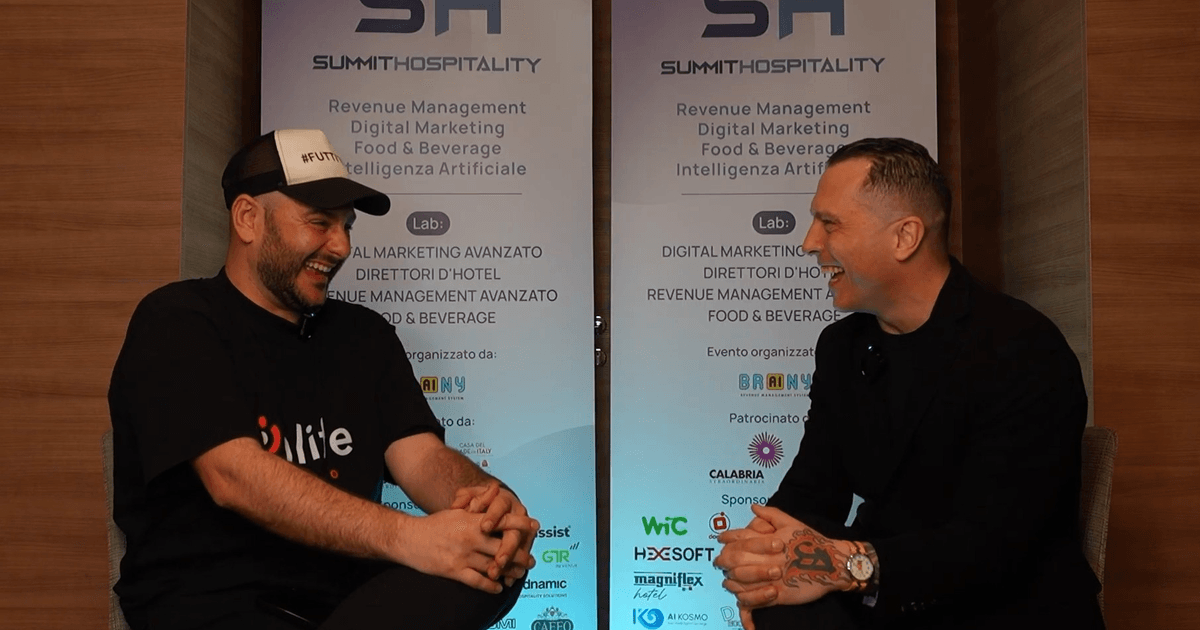
During the 4th edition of Summit Hospitality in Lamezia Terme, technophilosopher Simone Puorto was interviewed by vodcaster Samuele Di Iorgi on the evolving relationship between humans and machines within hospitality, a sector historically structured around anthropocentric assumptions.
The discussion reframes the dominant narrative surrounding artificial intelligence adoption. Rather than approaching AI as a set of tools to be integrated into pre-existing workflows, Puorto argues that its implementation requires a structural reconfiguration of processes, roles, and institutional expectations. In a context characterized by accelerating technological change, strategic planning becomes epistemologically fragile. Medium and long-term strategies can no longer be treated as stable projections, but must be conceived as provisional hypotheses subject to continuous revision.
A central theoretical claim advanced in the interview concerns the dissolution of the binary opposition between human and artificial. The two are no longer external or separable domains. Contemporary organizations operate within hybrid socio-technical ecosystems in which cognitive, operational, and relational functions are distributed across human and machine agents. The managerial challenge, therefore, is not defensive resistance to automation, but the development of governance frameworks capable of understanding, regulating, and, where necessary, constraining this hybridization.
Within this framework, Puorto introduces the concept of Humans-as-Luxury, elaborated by Puorto in a paper published in ROBONOMICS: The Journal of the Automated Economy. As routine and transactional interactions become increasingly automated, human intervention shifts from a default operational necessity to a strategic differentiator. Luxury is thus redefined. It is no longer primarily associated with aesthetic refinement or symbolic status, but with the intentional preservation of human presence in contexts where automation would be more efficient and economically rational.
The interview concludes with a reflection on imperfection as a constitutive dimension of human agency. In algorithmically optimized environments, imperfection acquires strategic value. Rather than being treated as inefficiency to be eliminated, it can function as a marker of authenticity, relational depth, and experiential distinctiveness. For hospitality, this reframing suggests that human limitation is not merely tolerated but can become a deliberate component of value creation.
This version of the interview has been translated using HeyGen.