
When Jamie Dimon, CEO of JPMorgan Chase, warns that society must prepare for AI-driven job displacement, the hospitality industry should not interpret this as alarmism. It should interpret it as a strategy.
AI is not coming for hospitality in a single sweeping wave.
It is arriving in layers.
And those who architect it deliberately will define the next decade of competitive advantage.
The Reality: Hospitality Is Not Immune – It Is Transforming
Hospitality has always been labor-intensive. That is both its strength and its vulnerability.
AI will not eliminate hospitality.
It will compress it.
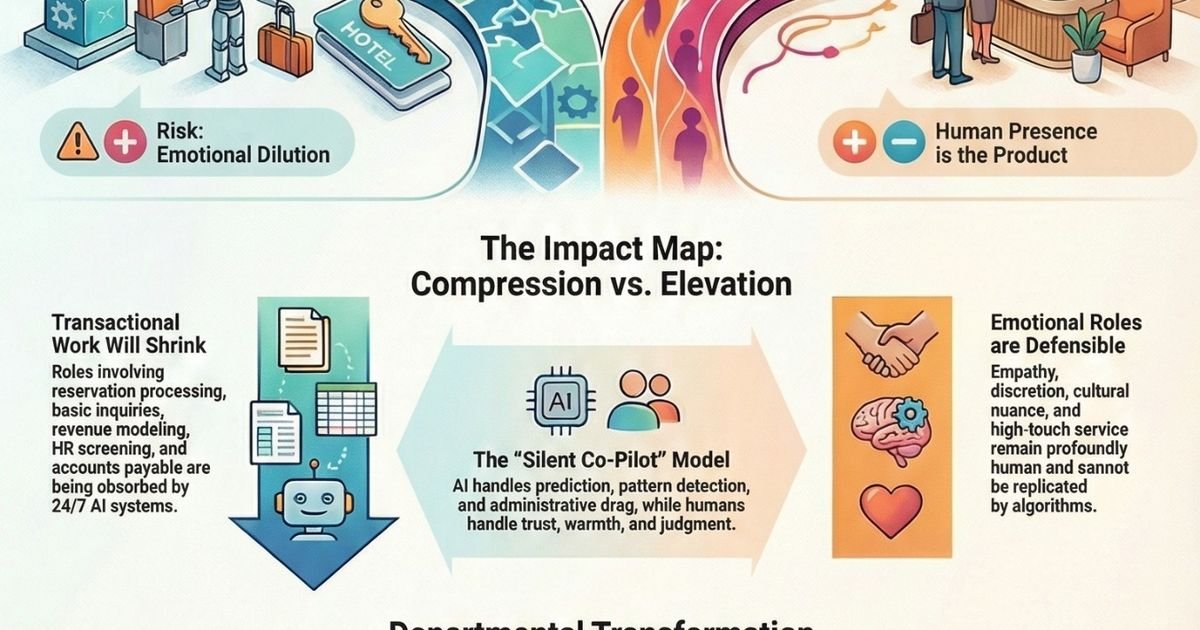
Transactional Work Will Shrink
-
Reservation processing
-
Basic guest inquiries
-
Revenue modeling
-
Procurement workflows
-
HR screening
-
Accounts payable
These layers are already being absorbed by AI systems that operate 24/7 with near-zero marginal cost.
The question is no longer “Will this happen?”
It is “How prepared are we for the redesign?”
The Critical Distinction: Automation vs. Augmentation
There are two futures available:
Automation-led hospitality
Efficiency first. Labor reduction. Margin focus. Risk of emotional dilution.
Augmentation-led hospitality
AI handles friction. Humans deliver feeling. Technology becomes invisible infrastructure.
The second path is where true brand equity lives.
In luxury segments – and increasingly in premium senior living – human presence is not a cost center. It is the product.
AI should remove the mundane so teams can elevate the memorable.
Where the Impact Will Be Felt Most
Revenue & Commercial Strategy
AI-driven forecasting and dynamic pricing will eliminate manual spreadsheet-based revenue analysis.
Mid-level analyst roles will compress.
But senior commercial leaders who understand positioning, demand elasticity, and feeder markets will become more valuable than ever.
The machine predicts.
The strategist decides.
Front-of-House
Chatbots will answer the obvious questions.
Digital concierges will handle logistics.
But empathy, discretion, cultural nuance, and high-touch service remain profoundly human.
The scripted front desk disappears.
The experience curator rises.
Back-of-House
Procurement, compliance tracking, predictive maintenance, and financial reconciliation will become algorithmic.
The hospitality organization chart becomes flatter.
Less administration. More orchestration.
Travel Will Be Algorithmically Flattened
Standardized travel planning is vulnerable.
AI can already:
Commodity travel gets compressed.
Curated, experiential, emotionally resonant travel becomes premium.
The more generic the product, the greater the risk.
The more human the experience, the stronger the moat.
The Labor Question
Hospitality has historically absorbed displaced workers from other sectors.
If AI compresses banking, retail, and logistics roles, hospitality may see increased labor supply.
But here is the paradox:
Low-skill roles face wage pressure.
Digitally fluent hospitality leaders become scarce and expensive.
The future GM will need:
This is no longer optional.
What “Putting the AI into Hospitality” Actually Means
It does not mean replacing people.
It means:
-
AI handles prediction.
-
AI handles pattern detection.
-
AI handles administrative drag.
-
Humans handle trust, warmth, judgment, and cultural nuance.
AI becomes the silent co-pilot.
The human remains the hero.
If technology becomes the visible protagonist, the emotional contract with the guest weakens.
If humans remain the face and AI strengthens the backbone, the brand grows stronger.
The Strategic Imperative
Leaders in hospitality and senior living should now be asking:
-
Which roles are transactional and compressible?
-
Which roles are emotional and defensible?
-
Are we redesigning workflows before the market forces us to?
-
Do we have AI governance guardrails in place?
-
Are we measuring productivity – or just headcount?
The organizations that act early will shape pricing power, margin resilience, and guest loyalty.
The ones that delay will face reactive restructuring.
The Bottom Line
Dimon’s warning is macroeconomic.
For hospitality, the message is strategic:
AI will thin the operational layers.
It will elevate the experiential layers.
The brands that thrive will not be the most automated.
They will be the most intelligently augmented.
The intelligence may be artificial.
The experience must remain profoundly human.
Made with the help of AI, but with a HITL