
There is only one film that has ever made me, not just cry, but positively hyperventilate, and that is the Richard Attenborough-directed film, Shadowlands (1993), chronicling the romantic relationship between world-renowned writer, C.S. Lewis, and American poet, Joy Davidman, and starring Anthony Hopkins and Debra Winger (winner of the 1994 BAFTA for ‘Outstanding British Film’). So I was armed with tissues when I heard that the stage production of Shadowlands, originally produced by Chichester Festival Theatre in 2016, was finally arriving in the West End.
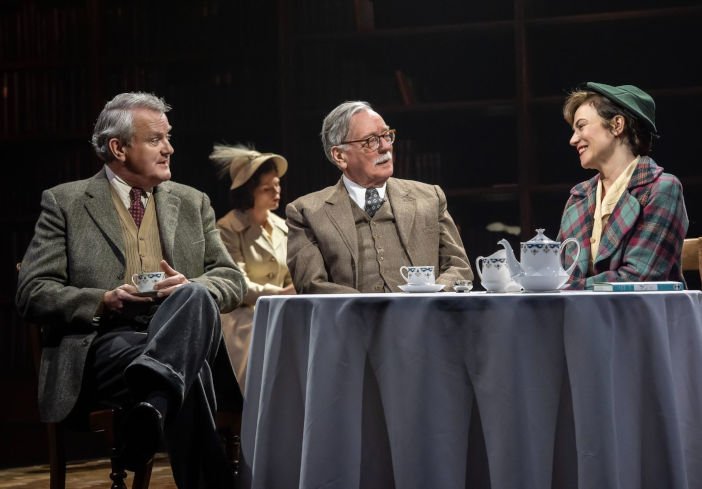
With a stage play by William Nicholson, who also wrote the original film screenplay, partly inspired by C.S. Lewis’s 1955 autobiography ‘Surprised by Joy,’ you know after only a few minutes exactly why the theatrical version of Shadowlands made it to London, directed by Rachel Kavanaugh and presented by Jonathan Church Productions, Trafalgar Theatre Productions and Tilted. Starring Hugh Bonneville (who has become something of a ‘National Treasure’ thanks to his role in Downton Abbey) as the Oxford scholar and writer of the Narnia books, C.S. Lewis, I’m not sure when I can remember such an enthusiastic standing ovation as the one which congratulated the cast following yesterday’s press night performance at the Aldwych Theatre.
Set and costume designer Peter McKintosh conveys the rigidity of Lewis’s academic and home life perfectly and, with a backdrop of bookcases, we find him to be a confirmed bachelor, living with his brother, Major W. H. Lewis ‘Warnie’ (Jeff Rawle), and whose only society are the Oxford dons with whom he enjoys debating theological matters, “I am as I am. The world is as it is. Whether I am content with that has very little to do with it.” But is Lewis really as content as he imagines? It is only when the American poetess, Joy Davidman (Maggie Siff), with whom Lewis has been corresponding for some time, decides to visit Oxford during a sojourn in England with her young son in the 1950s that he begins to wonder.
Siff is tremendous as Joy, a poetess from New York who, not being remotely intimidated by the snobbish Oxford dons she meets, endears herself to the audience, if not to Lewis’s associates, with her razor sharp wit; allowing us to appreciate how this straight-talking, perceptive woman must have been a breath of fresh air to Lewis. I could have believed that Debra Winger was on the stage before me, for Siff, whether by design or accident, seems to have precisely the same tone and manner. It is gratifying to note that Siff is indeed a New Yorker, something which I don’t doubt has helped her to tap into the character’s frankness and appreciation of life.
Lewis, without much consideration of his brother Warnie, invites Joy and her son, Douglas, to spend Christmas with them in Oxford, during which time she receives a letter from her husband asking for a divorce. Although Joy eventually relocates to Oxford with Douglas, and Lewis marries her secretly to enable her to achieve British citizenship, there is no romance on the horizon. It’s clear that Joy would like there to be, but fears losing Lewis entirely if she forces the point.
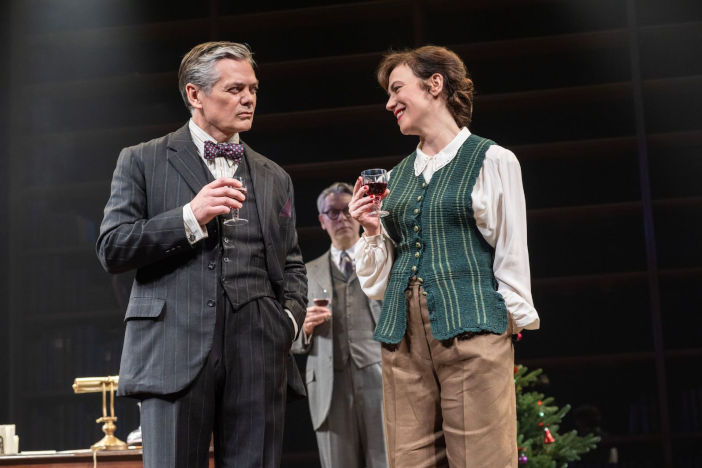
It’s refreshing to see a love affair where both parties are middle-aged – one of whom being extremely set in his ways – with Bonneville and Siff conveying a spectacular breadth of emotions, not least their sadness and despair when Joy is revealed to be terminally ill with cancer, something which finally makes Lewis realise that their friendship is far more than that. I needn’t have worried that the stage experience would never be able to move me in the way that the film does; this production, uniting wonderful writing, flawless acting and an atmospheric design with rotating stage, had me weeping through most of the second act, set between Joy’s hospital room and Lewis’s home, something that is a unique experience for me after seeing and reviewing hundreds of plays over the years.
Bonneville and Siff’s chemistry mirrors that of Anthony Hopkins and Deborah Winger in their power to make you feel pain; allowing me to forget the film version entirely and become immersed in everything which befalls the ill-fated characters who must face up to the fact that death will separate them before they are ready – all the more poignant because we know it to have been based on a true story. It doesn’t matter that Joy wasn’t a beauty in real life, or that she had two sons rather than one, Nicholson’s writing conveys how two people can come together to make the other more whole than they believed possible – something that can only be felt because of Bonneville and Siff’s impeccable delivery and strong support from the rest of the cast.
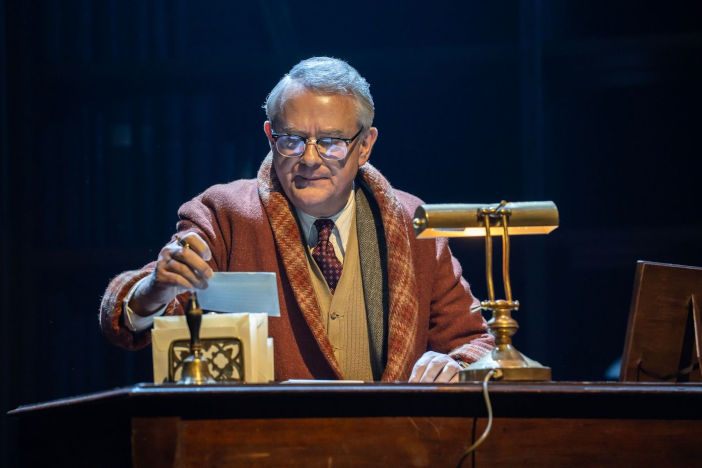
“Experience is a brutal teacher, but you learn fast,” Bonneville as Lewis tells us, lending an intimacy to scenes in which we observe the ascent of his now realised love for Joy. Never have I seen a play that so succinctly captures the human condition and the inevitable grief all of us will experience on losing the person we cherish most, or the confusion any religious man must feel on being deprived of the one he loves so senselessly. “Pain is God’s megaphone to rouse a deaf world. Why must it be pain? Why can’t he rouse us more gently, with violins or laughter?” I defy anyone to leave the theatre unmoved by Shadowlands, especially those who have known grief. Yet any pain one feels, just like Lewis’s, is off-set by tremendous gratitude.
Shadowlands at Aldwych Theatre, 49 Aldwych, London WC2B 4DF until 9 May 2026. Approximately 2 hours 20 including an interval. For more information and tickets please visit the website. Production photographs by Johan Persson.