
Executive Summary
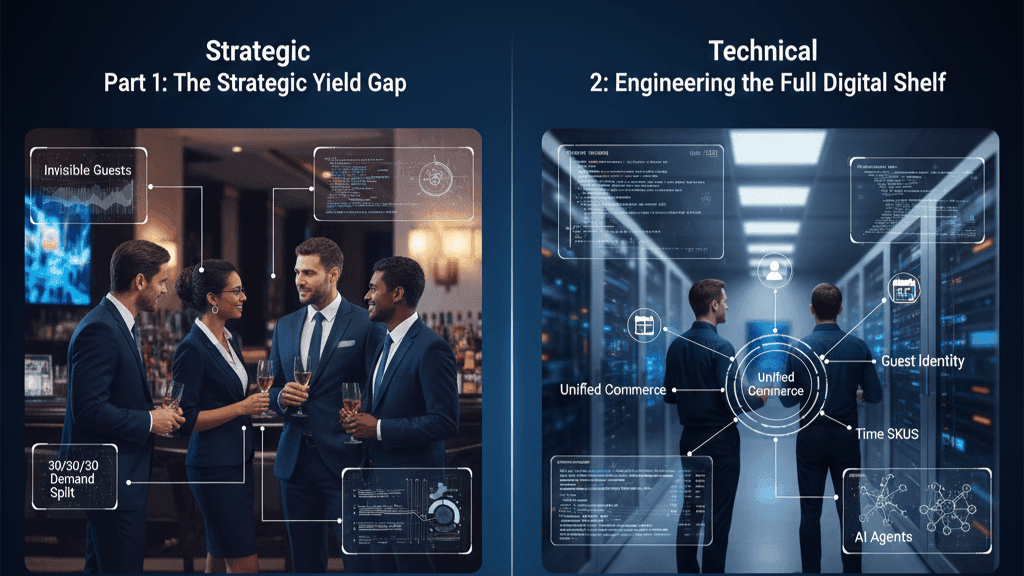
In Part 1 of this series, we identified the “Strategic Yield Gap”—the failure of the hospitality industry to digitally expose and transact with 50% of its potential asset value. We quantified a “30/30/30” demand split that proves non-staying and day guests represent a market share equal to staying guests.
As the roadmap to 2026 becomes clear, the properties that succeed will be those that view unified commerce as a business-wide operating system. It is time to stop managing check-in dates and start managing the total guest relationship.
Mark Fancourt, Founder & Principal Consultant, TRAVHOTECH
Key Insights: Getting the Revenue
-
The hospitality industry faces a Strategic Yield Gap by neglecting non-staying guests, representing untapped revenue.
-
A unified commerce architecture shifts focus from reservation IDs to Guest Identity to enhance guest relationships and revenue.
-
Implementing atomic transactions and a normalization layer improves integration and reduces basket abandonment.
-
Adopting Time-Based Retailing allows hotels to sell time-limited services, maximizing resource utilization and revenue.
-
As AI Agents gain influence, ensuring visibility on the Full Digital Shelf becomes essential for capturing future bookings.
A Collaborative Pathway to Execution
This paper represents a continued collaboration between TRAVHOTECH and MediaConcepts, bridging the gap between strategic consultancy and technical delivery. To “get the revenue you are not getting,” a hotel unified commerce architecture must move toward an identity-first, atomic commerce model. This provides the operational blueprint for that transition.
Pivoting from Reservation ID to Guest Identity
The primary barrier to unified commerce is the legacy reliance on the stay date as the gatekeeper for transactions. If a digital platform requires a “Check-in Date” before it allows a guest to view spa availability or book a table, it has already surrendered 60% of the market.
The Identity-First Architecture
TRAVHOTECH’s maturity framework dictates a move toward Guest Identity as the transactional anchor. In this model, the system recognizes a verified 360-degree profile—connecting digital identifiers, preferences, and historical behavior—independent of a room booking. By removing room-centric gatekeeping, hotels move from managing a “stay” to managing a “relationship” across the entire estate, unlocking a measurable Lifetime Value (LTV) that extends far beyond a single check-out.
The Technical Reality: Atomic Transactions and the Normalization Layer
Delivering the Full Digital Shelf is an integration challenge, not a front-end design exercise. Architectural research by MediaConcepts has demonstrated that the traditional “request-based” model for ancillary services is a primary driver of basket abandonment.
THE CONFIRMATION GAP
In legacy models, a room might be confirmed instantly while a spa request is sent to a manual queue. This “confirmation gap” creates guest anxiety and operational distrust. By 2026, commerce must be Atomic: the entire itinerary (Room + Spa + Table) must be committed to all underlying systems (PMS, Spa PMS, POS) simultaneously or not at all.
Normalizing Disparate Data Models
A key technical hurdle is that a “Room Night” in a PMS is a fundamentally different data object than a “Treatment” in a Spa system. A unified commerce layer acts as a Normalization Engine, translating these disparate models into a single, unified availability and pricing stream. This allows for complex “edge cases”—such as multi-system cancellations—to be handled automatically.
Engineering the “Time SKU” for Resource-Aware Yielding
To maximize non-room revenue, the technical architecture must move toward Time-Based Retailing. While hotels are experts at selling “nights,” they often lack the engineering to sell “minutes” or “hours” with the same fluidity.
The commerce engine must treat Time as the primary SKU. This allows the business to transact with high-value, time-limited assets:
-
60-minute targeted spa treatments.
-
4-hour luxury cabana rentals.
-
90-minute specialist sports coaching or golf simulator sessions.
Engineering for Time-Based Retailing also enables Resource-Aware Yielding. If a spa has high therapist availability but low room occupancy, the system can dynamically yield those “Time SKUs” to local residents in real-time.
The transition to unified commerce is ultimately an exercise in data orchestration. By centralizing guest identity and real-time inventory at the architectural level, we move beyond the silos of the 2010s to treat the entire estate as a single, machine-readable transactional asset.
John Bowen, Founder & Principal Consultant, MediaConcepts
The Foundation for the 2026 Agentic Economy
We are entering an era where discovery and booking are increasingly mediated by AI Agents acting autonomously. These agents do not “browse” websites; they query APIs for transactional certainty.
If your high-margin assets are not on the Full Digital Shelf, they are effectively invisible to the agentic economy. Properties that expose their full transactional reality ensure they remain bookable in a landscape where roughly 40% of digital bookings are expected to pass through AI-driven environments by late 2026.
MARKET DATA: THE PRE-BOOKING MULTIPLIER
According to Google and Arival, travelers who book their activities before they arrive on-property spend 47% more on lodging and 81% more on local transportation than those who wait. Capturing intent at the booking moment is the primary driver of total trip value.
Operational ROI: Financial Reconciliation and Labor Recovery
The transition to a hotel unified commerce architecture is often viewed as a cost, but MediaConcepts’ benchmarks reveal significant recovery in operational efficiency.
Labor Hour Recovery: Removing manual reconciliation between the booking engine and the Spa PMS or Dining POS has been shown to save thousands of working hours annually. This allows staff to move from data entry to high-value guest engagement.
Automated Financial Reconciliation: A unified commerce layer provides a single source of truth for payments and tokenization. This ensures financial data is reconciled at the moment of transaction, reducing errors and improving cash flow visibility.
Strategic Outcome: The Roadmap to 2026
TRAVHOTECH’s maturity model categorizes the journey into four stages. Most properties currently reside in Stage 2 (Digital Silos). The shift to Stage 4 (Unified Commerce) is a valuation play; digitizing the shelf directly correlates to an increase in GOPPAR and overall asset value.
Missed the Strategic Blueprint?
This operational guide is the technical “how-to” that follows our strategic “why.” If you haven’t yet explored the data behind the Strategic Yield Gap or the 30/30/30 Demand Split that defines modern luxury hospitality, we highly recommend revisiting Part 1: Why Luxury Hospitality Digitally Ignores 50% of its Revenue Potential. Understanding the scale of the “revenue you are not getting” is the essential first step before engineering the Full Digital Shelf described here.