
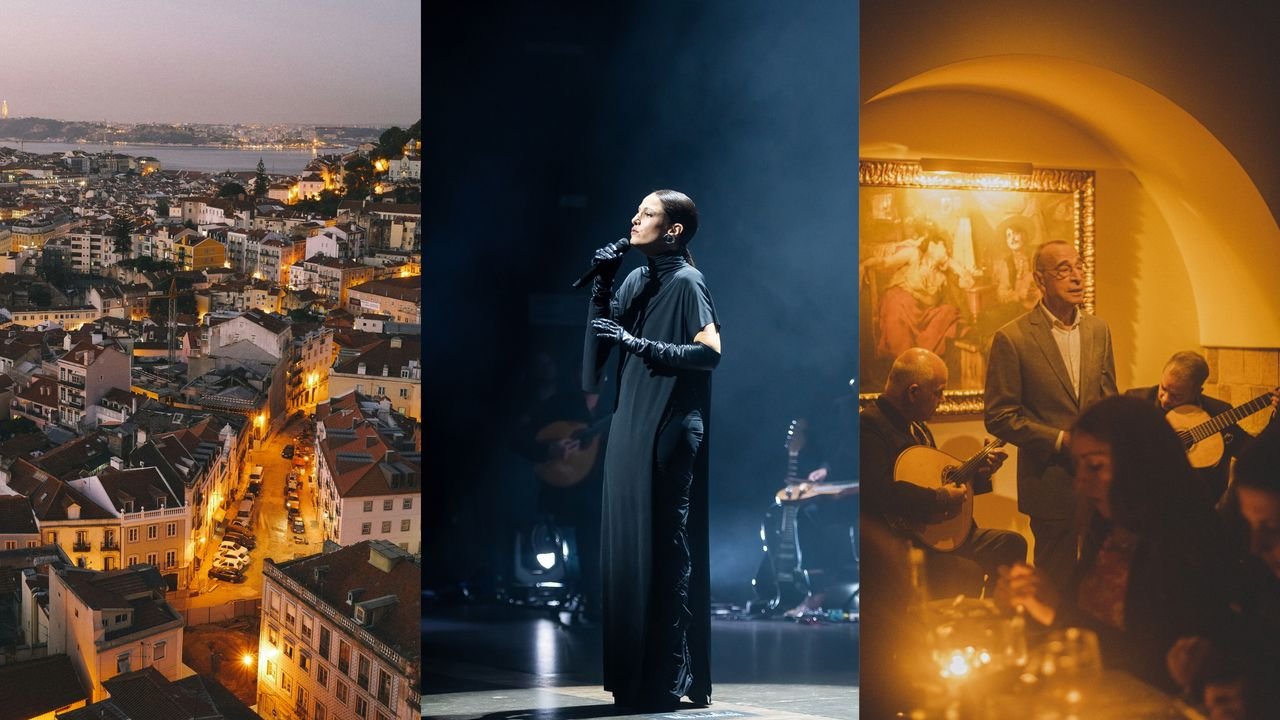
“Lisbon is the city of fado,” says Portuguese singer Carminho. “You have to experience it when you’re there.”
Carminho, who recently collaborated with Rosalia on the song “Memória” and released her latest album “Eu Vou Morrer de Amor ou Resistir” at the end of 2025, knows a thing or two about the Portuguese music tradition known as fado. “I started to practice while in my mother’s belly—she’s a singer, and she owned a fado house in Lisbon, and my brothers and sisters and I were all surrounded by fado.” Though Carminho’s first performance was at the age of 12, her mother says she started singing somewhere around age four.
The melancholic sound of the genre, whose early 19th century roots continue to grow in the country’s modern music scene, is best experienced in a cozy fado house, or fado bar, where the singers croon with zero amplification (it’s all natural acoustics here). The songs, often about lost love or nostalgia, are moving even if to guests who don’t understand the language. “Fado is it’s own language,” Carminho says.
Within Portugal, fado has had its ups and downs in popularity, but the genre is finally seeing a new era embrace its sound with vigor. “When I started performing, my friends didn’t want to listen, and the generation before them was even less interested. In some ways fado was tied to the old Portugal—with political issues, with the dictator—but about 15 years ago, people began to understand that the music itself was stronger than the preconceptions people had about it.”
It was, specifically, the 2008 crisis that spurred this change, Carminho says. “People were trying to understand how to survive when they lost their jobs or didn’t have money to pay their houses, and many people began small businesses based in the identity of Portugal,” says Carminho. “It was a way to recuperate our pride. We realized our gold was within the richness of our culture, and then began a boom in Portugality, and fado was part of that.”
Suffice to say, if you’re headed to Portugal and spending any time in Lisbon, listening to fado in a dimly lit taverna is a special experience to be had—one that embodies the spirit of Lisbon past and present. Some fado houses are more formal, with an entire dinner served upon white tablecloths, and a well-orchestrated run of show led by a renowned group of performers who sing between tables. Others are more spontaneous, marked by close quarters, low ceilings, Portuguese comfort food, and the possibility that a famous singer may drop by unannounced—or even invite a member of the audience up to sing. Wherever you go, just remember a few house rules: “You don’t speak when a fadista is singing,” first and foremost, says Carminho. You may want a reservation, especially at the big and well-known spots, but there are also low-profile fado houses where you can just show up, have a drink, and see what happens. (It never hurts to have your hotel concierge call ahead and confirm if a reservation is needed.) Smaller houses may be cash only.
Below, Carminha shares her favorite places to experience fado in Lisbon—from the informal to the buttoned up, with a few trips down her own nostalgia lane.
R. dos Remédios 139, 1100-453 Lisboa
“Mesa de Frades is the fado house where I’ve spent the most years singing. I sang for eight or nine years in that fado house before I started my career. I had the most beautiful nights there when I was just amateur. It’s in one of the most characteristic neighborhoods in Lisbon called Alfama, and it has this authenticity to it.